
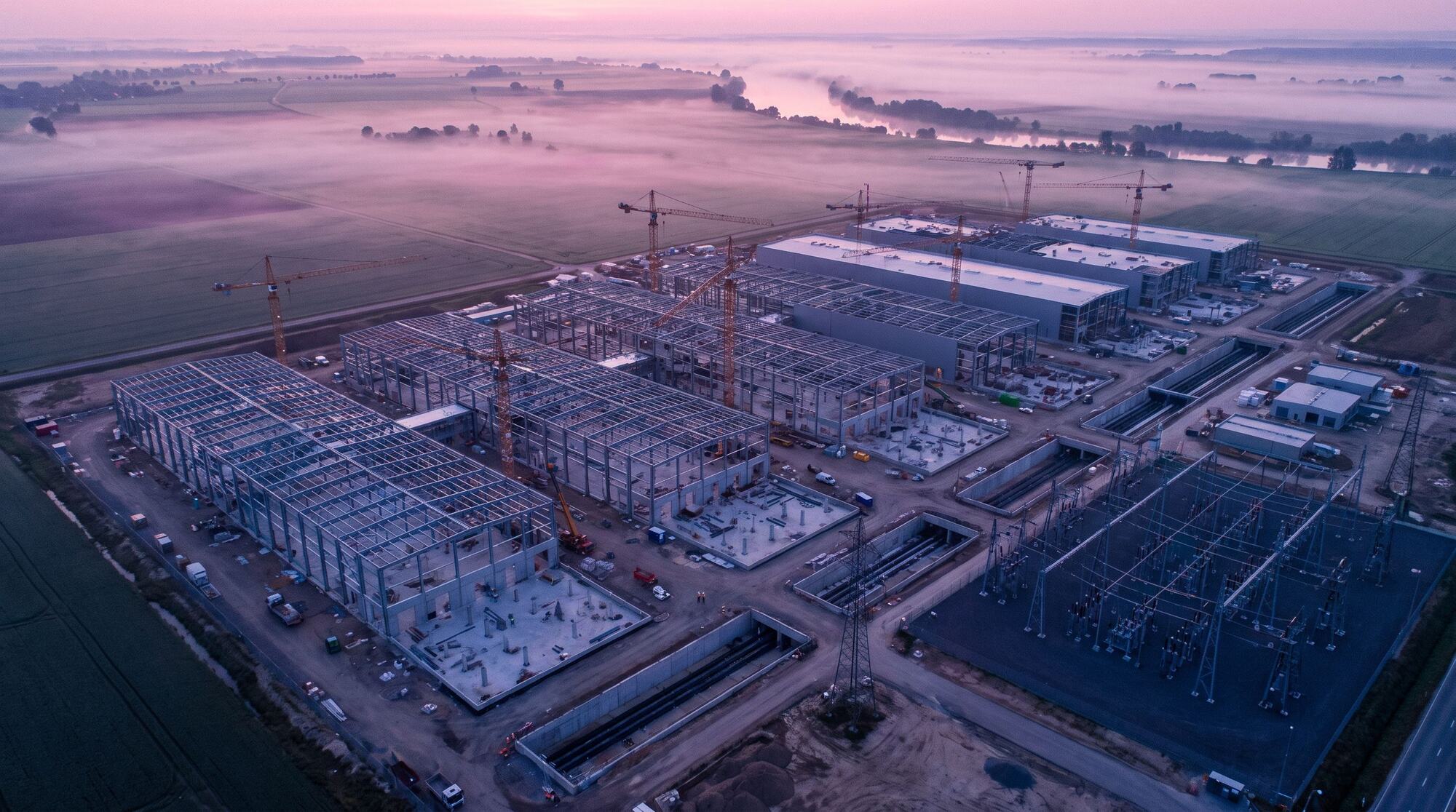
Seven Bets on a Budget Nobody Has Passed
Europe has put up to seven AI gigafactories out to tender, at €30 billion-plus, with 100,000 chips apiece at the largest sites. Only €1 billion of the EU's own money is legally committed. The rest waits on a budget that does not exist yet.
At 17:00 Brussels time on 3 December, the European Union will open the envelopes on the most ambitious computing project in its history. The EuroHPC Joint Undertaking wants up to seven "AI gigafactories": sovereign supercomputers big enough to train frontier models, spread across at least seven member states, built and running within 18 months of signature.
The deadline was supposed to be 12 November. On 1 October, a change notice on the EU's tender portal pushed it back three weeks "following request from the European Commission."
Three weeks later, Spanish news agency Europa Press reported that no bids had yet been filed, Spain's included. Nobody is walking away. The consortia are still closing their financing, and the money they are counting on is being negotiated in a different room.
Gigafactories
7
up to, in at least 7 member states
EU money committed
€1bn
of a €5bn EU share
Largest sites
100k
H100-equivalents, 4x JUPITER
EU capex cap
17%
of a site's IT spend
What Brussels is actually buying
The call, opened on 30 July under reference EUROHPC/2026/OP/0008, is split into two lots. Four "medium" gigafactories must reach at least 75,000 H100-equivalent chips. Three "large" ones must reach 100,000, roughly four times the size of JUPITER, Europe's first exascale machine. At full build-out the medium sites need at least 120 megawatts of IT load and the large ones 150.
The commercial model matters more than the chip count. EuroHPC does not own these machines. It buys access: the Joint Undertaking and the participating member states act as anchor customers, purchasing compute time over a five-year operating period, inside a framework contract that runs six and a half years in total.
The coordinator of each consortium must be EU-controlled. American hyperscalers are explicitly allowed in as anchor tenants. Bids are scored 40% on technical merit, 40% on finances and 20% on impact.
The legal plumbing took most of a year. Parliament approved the change to EuroHPC's mandate in December 2025 and the Council adopted it as Regulation 2026/150 in January.
The call itself was meant for late 2025, slipped to early 2026 and finally opened in high summer. If selection lands in early 2027 as planned, Euronews reports that construction would start in 2027 and operations by mid-2028.
The €1 billion that exists
The headline figure is "more than €30 billion." It is worth taking apart, because almost none of it is money anyone has yet.
When Ursula von der Leyen announced InvestAI at the Paris AI Action Summit in February 2025, it came with a €20 billion fund for four gigafactories.
What reached the tender is smaller and spread thinner: up to €10 billion of public money for up to seven sites, of which the EU provides at most €5 billion and member states must at least match it. Private investors are expected to bring at least €20 billion more.
Inside the EU's €5 billion, the split is what should worry bidders. Phase 1 money, €100 million per medium site and €200 million per large one, comes from the current 2021 to 2027 budget. That is €1 billion in total, and it is the only EU money legally committed.
Phase 2, up to €400 million or €800 million per site, is in the specifications' own words "subject to the adoption of the MFF 2028-2034," depends on a successor body to EuroHPC, and cannot be awarded before the end of 2027.
The EU's share of any site is also capped at 17% of its IT capital spending. With the tender putting the cost of a gigafactory at "at least EUR 4 to 5 billion," the public purse is a minority shareholder in its own flagship.
The money
€30 billion-plus on paper. €1 billion in the bank.
EU, Phase 1 · €1bnCommitted
From the 2021 to 2027 budget. The only money that exists today.
EU, Phase 2 · €4bnPending
Subject to the 2028 to 2034 budget; cannot be awarded before 2028.
Member states · €5bnMust match
At least euro for euro with the EU share, from national budgets.
Private capital · €20bnTo raise
At least €20bn across seven sites; the EU share is capped at 17% of IT capex.
The budget that Phase 2 depends on is in trouble. The Irish Council presidency's negotiating box, published on 10 October, puts the 2028 to 2034 framework at €1.62 trillion, 8% below the Commission's proposal.
The European Council on 15 and 16 October produced no breakthrough, and Agence Europe reports that leaders no longer rule out missing the end-of-2026 target. Council President António Costa is due to table figures by late November. In other words, the bids will arrive in the same fortnight that member states argue over whether the money behind them exists.
Who is placing the bets
The demand to host one is not in doubt. When the Commission asked for expressions of interest in 2025, it received 76 from 16 member states, covering 60 sites and more than three million GPUs between them. That field has since narrowed into national champions.
Spain and Portugal are bidding together. Madrid approved €719 million through its state tech holding SETT for a vehicle with Santander, ACS and Telefónica, spread over Móra la Nova in Catalonia and San Fernando de Henares near Madrid, with Sines as the Portuguese leg.
France's AION consortium brings together Iliad's Scaleway, Orange, EDF, Capgemini, Bull and Ardian, aiming for 100 megawatts first and a gigawatt eventually. Italy is assembling a Treasury-owned newco with Eni, Enel, Leonardo, Snam, Terna and CDP. Czechia's CRA signed with Bull on 21 October, pitching the gigafactory for Central and Eastern Europe.
Germany, Europe's largest economy, has the opposite problem: too many bidders. Deutsche Telekom, Schwarz Digits and Ionos with Hochtief have all lined up separately, talks about joining forces have not produced a deal, and Berlin has reserved €805 million for whichever wins.
The Netherlands, home to ASML and one of Europe's densest data-centre markets, is sitting this one out, putting its money into a smaller AI Factory in Groningen instead.
The bets
Who is lining up for seven slots
- ES·PTNamed
Spain + Portugal
SETT, Santander, ACS, Telefónica, Multiverse
Iberian bid: Móra la Nova and San Fernando de Henares in Spain, Sines in Portugal. Madrid has approved €719m.
- FRNamed
France
AION: Iliad/Scaleway, Orange, EDF, Capgemini, Bull, Ardian
100 MW first, 1 GW eventually. A second consortium around 2CRSi and Outscale has been reported.
- DEForming
Germany
Deutsche Telekom, Schwarz Digits, Ionos with Hochtief
Several rival bids, talks on joining forces unresolved. Berlin has reserved €805m.
- ITForming
Italy
Eni, Enel, Leonardo, Snam, Terna, Fibercop, CDP
A Treasury-owned newco, starting at €1.2bn and possibly rising above €5bn.
- CZNamed
Czechia
CRA with Bull
MoU signed 21 October, pitched as the gigafactory for Central and Eastern Europe.
- PLForming
Poland
Candidates include DL Invest and Beyond.pl
Targeting the medium lot.
- FIForming
Finland
Nokia-led consortium
Filed an expression of interest in 2025; 2026 bid not yet confirmed.
- NLOut
Netherlands
No national bid
The cabinet declined to fund a gigafactory and backs the Groningen AI Factory instead.
Notice who is on these lists: telcos, utilities, construction groups, state holding companies and banks. With the partial exception of France, the consortia are built to pour concrete and connect power, not to train models. That is a reasonable division of labour, but it says something about who will actually use the machines.
Small next to the frontier
Here is the uncomfortable part. A large gigafactory at minimum size is 150 megawatts. All seven at minimum size add up to roughly 930 megawatts, less than OpenAI and Oracle's single Stargate campus in Abilene, Texas, where six of eight buildings are now delivered on the way to 1.2 gigawatts. Meta's Hyperion campus in Louisiana is planned for five.
Bids can and will exceed the minimums, and some consortia talk about gigawatt ambitions. But the structural gap is not a question of a few hundred megawatts. Bruegel's September policy brief estimates Europe has about 5% of the world's AI compute, around two gigawatts operational in 2026 against roughly 35 in the United States.
The scale
Seven gigafactories, at minimum size, still fit inside one American campus
- EU gigafactory, medium lot (minimum)120 MW
- EU gigafactory, large lot (minimum)150 MW
- All seven EU gigafactories (minimum)930 MW
- Stargate Abilene, Texas (OpenAI, Oracle)1.2 GW
- Campus IA, Fouju, France (Mistral, MGX)1.4 GW
- Meta Hyperion, Louisiana5 GW
~2 GW
AI compute operational in the EU in 2026
~35 GW
in the United States, per Bruegel (September 2026)
The most telling number may be one that sits outside the programme. Europe's largest AI construction site right now is the 1.4-gigawatt Campus IA at Fouju, east of Paris, where works began after a prefectural permit in July.
It is backed by Mistral, Nvidia, Bpifrance and the Abu Dhabi investor MGX, and it did not wait for Brussels. Mistral itself raised a €3 billion Series D in September.
Further north, OpenAI has stepped back from Stargate Norway, and Microsoft has taken more than 30,000 Rubin GPUs at the Narvik site instead. European compute is being built, at scale, by private money and American customers. The gigafactories are the public answer to that, not the first mover.
The constraints money cannot buy
The tender gives winners 18 months from signature to operation. Europe's grid does not move at that speed. In the big data-centre hubs of Frankfurt, London, Amsterdam, Paris and Dublin, think tank Ember found that new grid connections take seven to ten years, and in some cases up to thirteen.
Bruegel puts typical permitting for a large data centre at 42 months in Germany against 24 in the United States. Industrial electricity in Europe remains structurally more expensive than in America, and the shock to energy markets this year has not helped.
That arithmetic quietly decides the competition. An 18-month clock favours sites that already have a grid connection, a permit and a power contract in hand: former industrial plots, existing data-centre campuses, places next to hydro, nuclear or a large substation.
A brilliant bid on a greenfield site with a connection date in 2031 should lose to a dull one that can switch on in 2028.
Chips are the other dependency. The Commission has memoranda with Nvidia, AMD and Qualcomm, but every one of these machines will run on American silicon, under American export rules that are still being rewritten after the AI Diffusion Rule was rescinded.
Europe makes the lithography machines that print the world's AI chips, and buys almost none of them. The gigafactories do not change that.
Who will use them
The hardest question is the one the tender answers least. A frontier training cluster needs a frontier lab, and Europe has essentially one. The Berlin think tank Interface argues that, with Mistral the only obvious candidate, a single anchor customer is unlikely and demand has to be pooled across research, industry and the public sector.
Open Future warns that letting hyperscalers in as anchor tenants cuts against the sovereignty case for the whole programme, at a time when AWS, Microsoft and Google are expected to take about two thirds of European data-centre demand by 2028.
Bruegel goes further: it finds no credible evidence that private markets are failing to finance AI compute in Europe. The binding constraint, it argues, is speed to operation. If that is right, then subsidy is the least important lever Brussels has, and permits, grid priority and public demand are the important ones.
What to watch
- 3 December. How many bids arrive, and in which lots. A thin field in the large lot would be a signal in itself.
- The December budget summit. Without an MFF deal, Phase 2 remains a promise, and bidders will price that risk into their financing.
- Germany. Whether Telekom, Schwarz and the others consolidate. Three German bids competing for one German slot is a gift to everyone else.
- Grid letters. Whether winning bids can show firm connection dates. That, more than chip counts, will tell you which sites go live in 2028.
- The anchor customers. Which labs, companies and public bodies sign up to buy the compute, and whether any of them are European frontier labs.
What it means for Europe
The gigafactories are not going to win the race to superintelligence for Europe. They were never sized to. What they can do is keep a slice of the machine on European soil, under European control, at a moment when almost every other large European AI campus is being financed from Abu Dhabi or leased to Seattle and Redmond. That is worth having.
But the programme is fighting the last war with the next budget. It spreads modest public money across seven sites, ties most of it to a framework nobody has agreed, and asks consortia to beat a grid queue measured in years with a deadline measured in months.
Europe would get more from three gigafactories that switch on in 2028 than from seven that are still waiting for a substation in 2031. The envelopes open on 3 December. The real test is what gets plugged in after that.